I Broke My Favorite Mug, Fixed It With Gold, and Finally Understood My Burnout
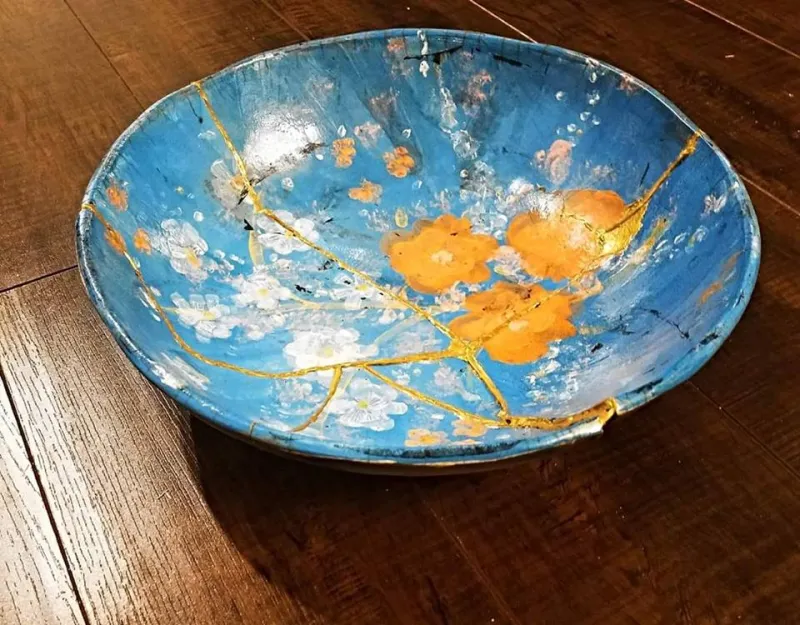
Photo: Ruthann Hurwitz, CC BY-SA 4.0, via Wikimedia Commons
The mug hit the kitchen floor on a Tuesday, and honestly, so did I.
It was my favorite one—a chunky speckled ceramic thing I'd bought at a craft fair in Portland three years ago. I'd been running on five hours of sleep, three back-to-back Zoom calls, and a caffeine schedule that could legally be described as a dependency. I bent down to grab the pieces, and instead of just sweeping them up, something in me paused.
I didn't throw them away. I don't fully know why. But I'm glad I didn't, because a month later, that mug taught me more about recovering from burnout than any wellness app ever has.
The Art of Not Hiding the Damage
Kintsugi is the Japanese craft of repairing broken pottery with lacquer dusted with gold. The cracks don't disappear—they become the most beautiful part of the object. A repaired kintsugi bowl is often worth more than it was before it broke.
Sit with that for a second, because American hustle culture has the exact opposite philosophy. We break, and then we hide it. We take a "mental health day" and lie about having a dentist appointment. We come back from burnout whispering about a "family thing." We plaster gold over nothing and pretend the vase was never in pieces.
In Japan, the repair is the story. In the US, the repair is the embarrassing thing we're not supposed to mention in standup meetings.
So I decided to run an experiment on myself. One month of treating my burnout the way a kintsugi artist treats a broken bowl: not as a flaw to disguise, but as a break to honor.
Month of Visible Repair: The Rules
Here's what I committed to, loosely, imperfectly:
1. Name the break out loud. I told my manager I was burned out. Actually used the words. Terrifying. She responded with her own burnout story, because of course she did—everyone's carrying one.
2. Rest like it's the job. Not "rest after I finish this one thing." Scheduled, unapologetic rest. Two evenings a week with zero screens, one full weekend day a month doing absolutely nothing productive.
3. Therapy as craft time. I'd been putting off finding a therapist for a year. I booked one. If kintsugi is repair with gold, therapy is repair with whatever metal actually works for you.
4. Boundaries as lacquer. The glue that holds the repair together. I stopped answering Slack after 6 p.m. I declined two projects. Nobody died. I checked.
5. One slow, repetitive hobby. This is where the actual kintsugi came in. I bought a beginner kit—food-safe epoxy, gold mica powder, cheap practice ceramics—and started gluing my mug back together on Sunday afternoons.
What a Month of Gold-Filled Cracks Actually Felt Like
Week one was rough, and not because of the craft. Rest is uncomfortable when your self-worth is welded to your output. I kept reaching for my phone to "be productive" during rest blocks. My therapist called this "productivity withdrawal," and I laughed, and then I didn't, because it's a real thing and it's everywhere.
By week two, something shifted. Sitting there with trembling hands, fitting a shard of my mug back into place, I noticed my breathing slow for the first time in months. Kintsugi forces you to slow down—you can't rush lacquer, and you definitely can't rush epoxy. The repair only holds if you let each piece set properly.
Which is, I realized, exactly the mistake I'd made with my own recovery attempts. Every prior "recharge" was a long weekend, a rushed patch job, back to full speed before anything had time to set. No wonder I kept breaking at the same seams.
The Seams Become the Strength
Here's the practical takeaway, because I promised myself this wouldn't just be a vibes essay:
- Recovery needs setting time. A repair that's rushed fails at the same stress point. Build recovery periods that are actually long enough to cure.
- Document the break honestly. Write down what actually caused it—overcommitment, bad boundaries, a job that takes more than it gives. You can't reinforce a seam you won't look at.
- Gold costs something. Kintsugi uses real gold because the repair is worth honoring. Budget real resources for your recovery: money for therapy, time for rest, energy for the people who refill you.
- Don't aim to become unbroken. The goal isn't a mug that never drops. It's a mug with visible seams that knows exactly where its weak points are—and is stronger there.
By week four, my mug was back together, gold veins running across its side like a map of everywhere it had been. It's not perfect. It leaks a little if I let tea sit too long. I use it every morning anyway.
And me? I'm not "back to normal," and I've stopped chasing that. I'm the repaired version—slower in some places, more deliberate in others, with a few shiny seams that show exactly where I've been.
Genki, Reconsidered
The whole premise of this site is genki ga deru—gaining energy, feeling vital again. But a month of kintsugi taught me that energy doesn't come from pretending the break never happened. It comes from repair done with care, out in the open, without shame.
Your burnout isn't a manufacturing defect. It's a break in an object worth keeping.
Mend it with gold.